 Unearthed my late ’95 L.A. Times story about online message boards devoted to TV shows, and had to smile at how tame “the wild and wooly Internet” was compared to today. Also amusing: References to TV show long since gone and suggestions that David Letterman play Phoebe’s dad on “Friends.” Jeremy Pivens’ character on “Ellen” also drew criticism. And I love that I and/or the LAT felt compelled to spell out World Wide Web. I could go on, but won’t. It’s here, if you’re interested. Adding more of my older stories to my archives, for now accessed here.
digital media
Ted Kennedy, Internet pioneer
DG Creations, digital media, Writing Who would you have guessed was the first Congressman to have a website? Al Gore, right? Nope, it was actually fellow Harvard alum, and decidedly old school pol Teddy Kennedy. This is my favorite factoid yet to surface in the wake of Kennedy’s death late last night.
Chris Casey, Kennedy’s system administrator in the early ’90s, explains the backstory on Matthew Yglesias’s site. Apparently, I am not the only one to marvel at this ancient web artifact. The grayscale background! Early Netscape browser! BBS systems and ftp! Check out the comments if you, too, remember those days.
Casey wrote a book about the efforts to get Congress online, “The Hill on the Net: Congress Enters the Information Age”; he uploaded this 1994 screen grab to Flickr a few years ago.
Wyatt Cenac, vampire of comedy
comedy, DG Creations, digital media, TV, Variety, Writing In case you were wondering, Wyatt Cenac is not one of those rat-tat-tat jokesters in person. Not at first meeting, anyway. But make no mistake about it — he’s very droll. And sly.
During our interview a few weeks back, he made several stealth points about Sarah Palin and the media. Sadly, they didn’t make it in my Variety Comic to Watch profile, linked here. Not enough space to do them justice; besides, sometimes you have to be along for the ride.
Cenac, “Daily Show” exec producer Josh Lieb observed, is deceptive — he seems innocent but is very sharp-witted. When you relax your guard, “that’s when he kills you. He’s a vampire of comedy.”
If you have a few minutes, treat yourself to a couple of his bits from “The Daily Show.” In “Judgmental,” he amusingly riffs on Sonia Sotomayor’s name and supposed gang ties; in “Fled Sanford,” he wildly speculates about Gov. Mark Sanford’s activities while supposedly hiking the Appalachian Trail. I love how he breaks up during the latter.
Also wrote three profiles for the companion Comedy Impact Report: One on Sandra Bullock, who showed she still has serious comedic chops in “The Proposal”; another on comedians’ use of Twitter; and a third on Comedy Central’s Web sites, led by Erik Flannigan.
Glad she asked! ‘Free’ prodder
Books, digital media, N.Y. Times, WritingDeborah Solomon, she of the penetrating questions, took Chris Anderson to task for l’affaire Wikipedia in yesterday’s NYT, eliciting a revealing exchange.
First she asked whether he considered plagiarism an extension of his freebie thesis, which batted down thusly:
“I wish I could explain all my actions as being intellectually consistent, but this one is just plain old sloppiness. There are questions about whether one should cite Wikipedia, and I’m one of those who think you should.”
Nice slight of hand: He starts out on a self-deprecating note, then asserts a sense of honor about, of all things, crediting Wikipedia in a supposedly rigorous economic treatise. Luckily, Solomon calls him on it.
“Frankly, if you want to be a public intellectual, you shouldn’t be using Wikipedia to research a book of ideas in the first place,” she observes.
Anderson’s less than satisfactory response: “The level of scholarship and analysis on Wikipedia is improving by the day, and we ignore it at our peril.”
Again, note the self-righteous tone. Anderson clearly has the power of his convictions.
Solomon also touches on the quality issue, which bugged me so, noting that people have proven willing to pay subscription fees for HBO, but Anderson rejects that model as so 15 years ago. “The marketplace wants free,” he parries. “Consumers want free, and if you decide to set up a subscription service, then your competitor will make a free one.”
Did I miss something here? Is HBO really suffering because of the free TV or Web programming? If anything, struggles to replicate earlier programming success — a quality issue — seem to have been the issue. And I won’t even reiterate the iTunes example. Oh wait, I just did.
‘Free’: A paradox of expediency
digital media, Writing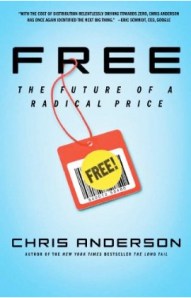 Raced through Chris Anderson’s “Free” online and while I’m not as critical as Malcolm Gladwell, I do have several issues with the book.
1. Anderson lets the book and mag bizzes off lightly. Is this because he wrote the book before the market REALLY took a dump, dragging both industries down along with the already cratering newspaper biz? Or is something more disingenuous going on here? After all he has a stake in both worlds as editor of Wired and book author. Anderson states that “books are a special case of print, like some glossy magazines, where the physical form is still preferred by most. The book industry is not in collapse, thankfully,” he continues, but this has not stopped “hundreds of authors” from experimenting in free with video interviews and the like.
That’s simply not true. The economic slump has hit the mag and book biz hard. Few glossies have been impervious; Wired has certainly taken its lumps, as outlined by the NYT not too long ago. Anderson himself alludes to disappearing bookstore shelves and newspaper book review sections shortly after this pronouncement.
This isn’t the only selective interpretation.
2. Anderson’s so blinded by his celebration of Free that he gives short shrift to counter phenoms. As convincing as he is describing how content creators and consumers can benefit from giving away their goods, he never really adequately explains why certain consumers willing pay for goods readily available for free elsewhere. King Gillette gave away razors to build demand for razor blades, just like the makers of Jell-O gave away free cookbooks to seed demand for the floundering dessert product. But Apple charges for music that can be found elsewhere for free, and sells millions of portable media devices at a healthy price.
Anderson argues that Apple is a beneficiary of Free because so many play free MP3s on iPod devices, and attributes the popularity of iPods to their storage capacity. “Before the iPod, nobody was asking to carry around an entire music collection in their pocket,” he writes. “But engineers at Apple understood the economics of abundance.” Supply created its own demand, he concludes.
This passage suggests Apple alone saw the market for portable MP3 players, when in fact Apple entered the market well after its competition and succeeded by selling, and marketing the hell out of, a sleek easy to use player. Apple doesn’t try to undersell the competition; it tries to create products consumers have got to have.
HBO follows much the same approach. But Anderson chooses to focus on the pay channel’s use of free clips on YouTube rather than its ability to command a premium. Never mind that free online clips are standard marketing procedure in Hollywood.
3. Anderson never adequately addresses where quality and aesthetics fit in the Free equation. He does acknowledge Hulu’s popularity, and ability to draw more advertising than YouTube due to consumer appetite for professionally produced content. But mostly he fixates on the tension between abundance and scarcity. It’s true that the digital revolution has lowered distribution costs tremendously, making it possible for amateurs to compete against the pros. If information really wants to be free, as Anderson argues, companies like Apple and HBO wouldn’t be so successful charging for their content.
Stewart Brand, who originally popularized the phrase, calls this apparent contradiction a paradox, noting that the tension between free and expensive information is what makes it so interesting. What’s more, he tells Anderson, “paradoxes keep themselves going because every time you acknowledge the truth of one side you’re going to get caught from behind by the truth on the other side.”
In other words, good luck pinning this down.
To give Anderson credit, he does a good job explaining the psychology of free and various returns content creators get from free goods. Besides traditional third-party exchanges (advertisers for access to viewers), there is “Freemium,” wherein creators up sell consumers. Bloggers, meanwhile, use “gift economy” to parlay the recognition they get from their free posts into paid assignments and speaking engagements.
Anderson practices what he preaches: He makes money from speaking engagements and has made this book briefly available for free online; he primed the pump with a cover story in his magazine. He also kept his own costs down by relying heavily on Wikipedia, a free but hardly unimpeachable source, then got into hot water when the material was not properly attributed in the book. Unfortunately his penchant for repurposing devalues “Free.” Is a book so readily available elsewhere really worth $26.99? Especially when it already seems dated? So much for its subtitle, “The Future of a Radical Price.”
As Virginia Postrel writes in her cogent NYT review, “the book is less about the future than the present and recent past, which Anderson surveys in a cheerful, can-do voice.”
There is much to be sorted out in the digital transformation of our culture. Too bad Anderson doesn’t see the value of quality control in the new land of the Free.
 Diane Garrett