Graveside rewards

Books, DG Creations, Surf N Pixels, Writing

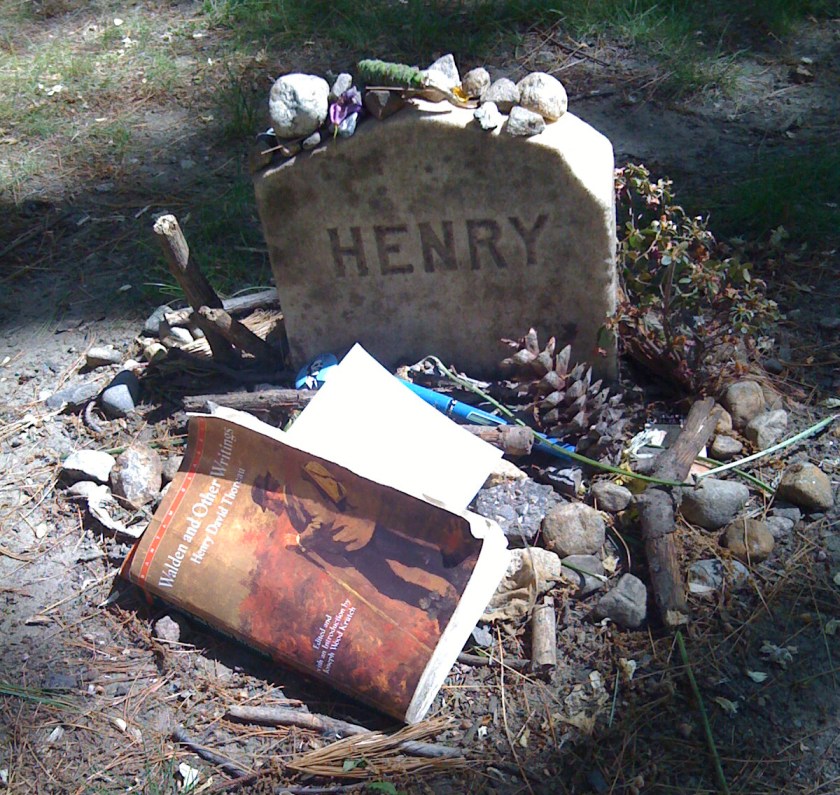
I’m not big on graveyards, but on my quick jaunt through New England, couldn’t resist a visit to the Sleepy Hollow cemetery in Concord, Mass., where many a famous writer is buried. As I’ve gotten older, I’ve grown to appreciate the engravings on those markers, the appeal of which escaped me as a kid when my Dad went through his embarrassing gravestone rubbing phase. Walking through the cemetery, I couldn’t help but imagine the families so lovingly memorialized  on these markers.

But I was even more amused by the modern offerings up on Author’s Ridge. My favorite: the Obama pin nestled next to a well-thumbed copy of “Walden” at Henry David Thoreau’s marker. The first shot is of the Thoreau plot, the second a close-up of H.D.’s marker, with the blue Obama pin barely visible.

thoreauplotthoreaucloseup

Ben Bradlee: Burying his own lede

memoir, Writing

bradleememoirSuppose you’re one of the best known newspaper editors of your generation, revered for your role bringing down a presidency. Wouldn’t you play that high in your memoir? 

Ben Bradlee did not. The long-time WaPo editor instead chose to craft “A Good Life” as a straight-forward chronological narrative, moving on from childhood illnesses to Harvard hijinks and so on. One third of the way through it, he’s still recounting his friendship with JFK, Watergate several chapters in the offing.

Somehow, I can’t imagine him letting a reporter get away with this approach in the paper. He’s burying the lede.

Bradlee, who wrote this a few years after his 1991 retirement from the Post, should have known better: You never want to lose your reader before you get to the really good stuff.

Memoir Mania: It’s Not Just Me

memoir, Writing

memoirstackWhy are memoirs so darn appealing? On my last trip to the library — I have time for such things, now that I’m a freelancer again — I picked up one book after another by or about familiar writers, finally limiting myself to four.

Sadly, “Looking for Anne of Green Gables,” the one that seemed most promising given my girlhood love for L.M. Montgomery’s stories about the fiery red-haired orphan, disappointed; Irene Gammel’s bio was a non-starter. But I quickly devoured the memoirs by Joe Queenan and Gustavo Arellano, plugging away at “Closing Time” even when the going got rough. Both had the benefit of covering familiar regions — Philadelphia for “Closing Time,” and Orange County for Arellano’s book of the same name — but that wasn’t the sole source of their appeal, any more than my familiarity with their work was.

I’m not the first to note the appeal of memoirs — part of the reason publishers keep getting in trouble with falsification is that they and/or writers retrofit fiction into the form — but haven’t quite figured out their mass appeal. I’m a journalist and have always loved literary essayists, so memoirs are a natural for me. But what about everyone else? Can we blame blogging for opening the floodgates to personal experience, or is blogging an extension of the same hunger that draws people to memoirs? Is this new — some consequence of our fractured communities — or an evolution? Did newspapers used to fill this niche? I’m sure others have expounded on this before.

But really, what is it about memoirs?

Closing Time: A Mean Machine Explains How He Got That Way

Books, Writing

closingtimeWanna know why Joe Queenan’s so mean? His Dad was a nasty drunk. And they lived in the projects! What a salve that must be for the stars he has so relentlessly skewered over the years. 

Queenan attempts to come to grips with his father’s legacy in “Closing Time,” but refuses to forgive him or apologize for his own nasty streak. Mostly he piles on the punishing details, describing in graphic detail his father’s beatings and his mother’s apparent indifference. And let’s not forget the family’s shameful slide into poverty in 1950s Philadelphia. 

“No afterglow accompanies these experiences,” Queenan writes a couple chapters in. “Nothing good ever came out of living in that project. One might argue that the degrading experience of poverty taught me to be ambitious and self-sufficient, but it would be more accurate to say that it taught me to be ruthless and cruel, indifferent to other people’s feelings, particularly if I was writing about them.” 

Pretty insightful. But Queenan immediately pivots blame on Hollywood for romanticizing the poor. It’s up to the reader to connect the dots between his previously stated impatience with the supposed problems of the non-poor and his evisceration of indulged Hollywood stars.

How cruel can he be? Sony was so outraged by Queenan’s vicious early 1990s takedown of Barbra Streisand that it threatened to withhold advertising from Movieline for a year. This pleased the editors tremendously — oh, how they cackled when the publisher told them about it — but I could see Sony’s point. Parts of “Sacred Cow” may have been wickedly funny but the article was undeniably mean. Queenan specialized in such pieces for the mag, then in its heyday of snarkiness, and has made a tidy sum wielding his poison pen for a series of major publications over the years, as he reminds us more than once in his memoir.

And to think he seriously considered entering the priesthood! But hey, there’s more money in sarcasm. 

Queenan does have a nice eye for telling detail: He vividly evokes Philadelphia’s modest Quaker-infused ethos, and the clannishness of its Irish Catholic enclaves in those eras, some of which overlap my stints in the city and its suburbs. The names were familiar, if not the particulars. 

orangecountyAlas, Queenan’s wicked wit is mostly absent in “Closing Time”; he’s too focused on chronicling the horrors he survived. It’s too bad he couldn’t have taken the page out of much younger Mexican-American satirist Gustavo Arellano’s recent memoir cum history, “Orange County.” Arellano’s father also battled the bottle, albeit more successfully than Queenan’s dad, and his family also lived in wretched housing, but the twentysomething scribe does not hold a grudge at his family, preferring to lampoon the county’s racist past and present.  

What would a younger, snarkier Joe make of his brutalizing march through the past? Hard to say. It’s also unclear whether Queenan successfully exorcised his demons with this tome; he admits that incidents from his past haunt him still, citing “beatings, lies, gruesome dental experiences, hijacked piggy banks, being sent to bed on an empty stomach.” Fortunately, the epilogue offers a brief ray of hope that, some 10 years after his father died, he’s found some peace through a satisfactory relationship with his own children. 

So maybe the cycle won’t repeat itself.
They didn’t get it then, don’t get it now

book reviews, Books, Writing

indecentFaced with proof that then Columbia prexy David Begelman forged checks, what did the company do? Throw him out on his ear? No, the board pressured top exec Alan Hirschfeld to keep the repentant former agent on staff, arguing that he was a good leader, and besides, the amount of money he stole wasn’t really that much.

Never mind the fact that Columbia, then as now, was a publicly traded company and the news was sure to leak out eventually.

“Indecent Exposure,” David McClintick’s absorbing chronicle of the late 1970s check kiting scandal, unfolds like a slow train wreck.  Reading it today, the parallels between the board’s arrogance and the banking industry’s recent behavior is hard to miss. 

The same type of moral relativism that financiers like Herb Allen employed informs today’s arguments that those AIG execs really deserve those retention bonuses despite having helped bring down the global economy. At the time of the Begelman scandal there was much tut-tutting over Hollywood’s laissez faire attitude toward such ethical breaches — supposedly Judy Garland waved off talk that Begelman had embezzled her while her agent — but the East Coast moneymen on Columbia’s board at the time seem to be just as tone deaf as producer Ray Stark, a tireless advocate for his pal Begelman.

Quite simply, they acted as if the normal rules did not apply to them. And this, McClintick reminds more than once, was but a few years after the Watergate scandal brought down the similarly arrogant Nixon administration. “All the President’s Men” had hit theaters the year before.   

Remarkable.

‘Girls’ gone sad

book reviews, Books, Writing

Finally caught up with “Girls Like Us” this weekend and powered right through it. It was a compelling read — obviously, or I wouldn’t have finished it so quickly — but a tad depressing. Did I really want to know that much about Carole King and Carly Simon’s hangups? Not really. 

Sheila Weller weaves together King’s and Simon’s story with that of Joni Mitchell, another seminal singer-songwriter from the 1970s. The three faced similar issues — the struggle to navigate fame, relationships and feminism — but the author’s decision to alternate between their stories doesn’t entirely work: Weller has a habit of switching from one woman to another and leaving the reader hanging. This is especially problematic if readers find one woman’s story less compelling than the others, as was the case with me and Mitchell. Seemingly to get around this, the author awkwardly inserts references to the other women in chapters about the third. In more adroit hands this might have worked more effectively. 

It’s easy to see why she built her narrative around these three, however: Their struggles rep different aspects of the feminist puzzle. Brooklyn-bred King got knocked up at 17 and wrote Top 40 hits with her husband before finding her own voice as a singer; Mitchell, uncompromising artist to this day, fled the Canadian plains after secretly giving up her child for adoption; Simon, a poor little rich kid from Manhattan, overcame reverse snobbery to deftly articulate the ambivalence of educated women weighing marriage and career. 

Growing up in the 1970s, it was hard to avoid their songs on the radio; I distinctly remember shouting out the words to “You’ve Got a Friend” and other “Tapestry” hits with my schoolyard chums; post college, Simon songs such as “That’s the Way I’ve Always Heard It Should Be” took on added relevance.  

Weller does a good job providing the cultural context; she’s very sympathetic to the plight of women. The book is at its liveliest chronicling the heady period of the 1970s when they broke through: It’s amusing to read who was sleeping with whom and when, and to read about the music scene in L.A., while Gloria Steinem prepared to launch Ms. mag in New York.  

The pleasure fades, however, as the women struggle to maintain their relationships, and crank out more hits. King, the seemingly steady earth mother, drops out to Idaho, where she marries two controlling mountain men; Simon  struggles to lead James Taylor out of heroin addiction while coping with her own debilitating neuroses. And Mitchell can’t find a lasting relationship with a musician of equal, or inferior, talent.    

Are these romantic woes due to fame, feminism or fucked up families? Weller never makes it clear. But she plumbs every romantic trial and tribulation to bathetic degree. One can only imagine what Mitchell or King, neither of whom talked to the author, would say about that. For a book titled “Girls Like Us,” Weller sure spends a lot of time on the men in their lives.


The Believers: Intoxicating vipers

book reviews, Books, Writing

Stayed up all night reading “The Believers,” it was that good. I knew I was in for a treat from the opening set piece at a London leftie party, and hungrily raced through it, finishing when the sun was coming up. Oh sure, I prolly could have savored Zoe Heller’s caustic prose a little longer, but her writing was a tonic for my frazzled soul. I didn’t want to put it down.

Certain critics have taken issue with the acerbic femmes dominating the book — these are not shiny happy people — but I found them quite amusing and surprisingly sympathetic. They may be judgmental snobs but they inflict as much misery on themselves as they do others. And they’re not nearly as creepy or malevolent as Heller’s censorious Barb in “Notes on a Scandal,” played so memorably by Judi Dench on the bigscreen.

Heller does a good job satirizing New York lefties and ascetics who consider themselves above sensual pleasures, serving up hapless Karla, a compulsive overeater, as the counterpoint to her reformed fattie mom and her forbidding sister Rosa. (Adopted drug-addicted sibling Lenny is the opposite extreme.)

The entire Litvinoff household revolves around charismatic lefty lawyer Joel, who has a debilitating stroke early in the story. His illness and the revelations it brings causes each character to come to grip with their own beliefs — political and religious — giving the book its title. Over the course of “The Believers,” each character reveals just enough to suggest how they dug themselves into their own particular hole.

The explanations don’t always add up: We’re supposed to believe, for example, that Audrey’s brash manner, developed as a coping mechanism as a teenage bride new to America, curdled into resentment at her husband’s infidelities and boredom with motherhood. By the time she realized she had become “a middle-aged termagant,” it was too late, Heller writes. That’s a little pat. But at least Heller doesn’t sugar coat or sentimentalize the behavior, like so many other writers would be tempted to do. And she suggests that Karla, patronized as caring by her family, isn’t quite as sympathetic as she seems, either, although this revelation doesn’t go anywhere. (Does the social worker really want to be a lawyer like her father, or does she want to surrender to happiness with kindly newsstand owner Khaled?)

Michiko Kakutani criticizes the book as a larger and messier undertaking than Heller’s previous two books, lamenting that “The Believers” lacks the “coiled and narrative suspense” of “Scandal.” That may be. Her latest tome is bookended by two hilarious set-pieces, but the wit is not sustained at that same high level throughout; impatient readers can barrel through middle passages quickly to find out how it all turns out if so inclined.

Nonetheless, it’s a good read. I can’t wait to go back and discover what I missed in my fervor to finish the story.

Stealing MySpace: Stuck in a moment

book reviews, Books, Random House, Writing

Ah, the perils of keeping up with the zeitgeist. No doubt when Julia Angwin began writing “Stealing MySpace” she was confident that MySpace was indeed “the most popular Website in America,” as the subhead claims.

Alas, that no longer seems to be the case. In recent months, Facebook traffic has surged to at least near parity Stateside, with Twitter coming on strong among the media and political classes. MySpace now seems so old hat that a reference in “He’s Just Not That Into You” sounded hopelessly dated (and therefore uncool) rather than hip and knowing.

Frankly, I questioned the point of Angwin’s book at this juncture. When I finally picked up the galleys, I was surprised by how doggedly the Wall Street Journal scribe clung to her premise. Yes, Facebook is growing, Angwin wrote more than once, before dismissing it as small potatoes compared to the all mighty and popular MySpace.

Except that’s not the case anymore. Last year Facebook passed MySpace worldwide and some of the most recent metrics suggest it has done the same in America. Its growing legion of middle-aged converts recently gained the attention of Time.

What I don’t get is why Angwin didn’t couch her claims a little better — especially as it became clear that Facebook was making such rapid gains last year. But I guess that would dilute the significance of her undertaking.

It’s too bad she didn’t do more to address those issues, for there is much of interest in the book. There are eye-opening stories about founders’ seedy dealings in spam and spyware, and plenty of juicy corporate intrigue following the News Corp. purchase.

Books about fast-moving developments are tricky, as I’ve noted before. But in order for these books to be as relevant as possible, writers and their editors have to be able and willing to adjust on the fly, just as a series of authors did when the economy plummeted last fall.

Here’s hoping that HarperCollins has greater success reacting to Internet time, if that phrase itself isn’t too hopelessly passe, with its new It Books imprint than Random House did with Angwin’s tome and “Stuff White People Like,” a lackluster spinoff from a popular blog. First up, per the NYT: “Twitter Wit,” a collection of posts, all no longer than 140 characters long.

Question is: Will we have had our fill of Tweets by then? By the time various movies about Facebook hit the bigscreen we will no doubt have moved on to something else. 

Lost in lit

book reviews, Books, Writing

Reading was my first big passion. Around second or third grade I began devouring books at my local library. I couldn’t wait for my mother to bring me there so I could check out more books. I spent so many hours with my nose buried in books my parents urged me to go outside and play. But I never stayed away from books long; I loved losing myself in literary worlds. 
After college I vowed never to stop reading for pleasure. But after a brief stint at a publishing house in New York, I drifted away. Instead of curling up with a good book, I found myself reading magazines or watching movies instead. 
Attempts to jump start my reading would bog down when I came across a well-regarded book that failed to engage. Was this really what it meant to be a grownup? I couldn’t help but recall my father mostly reading trade journals at the height of his career.  
Michelle Slatalla argued this case a few days ago in the New York Times, writing nostalgically about her own faded passion for book reading, made all the more bittersweet by watching her daughters lose themselves in novels. 
Books once affected her so deeply then that she can still remember the physical act of reading them. These days, however, books sit forlornly on her night table half-read, waiting for her to get the urge to dip into them again. 
Slatalla posits that readers lose their ability to be transported by books as they become more discerning. “It’s an inevitable byproduct of growing up that I formed too many opinions of my own to be able to give in wholeheartedly to to the prospect of living inside someone else’s universe.”
That’s not it. Critical thinking does not preclude surrender to art in any form, as Pauline Kael memorably telegraphed in “I Lost It at the Movies.” Grownup time constraints make that surrender more challenging, but by no means impossible. 
I rediscovered my passion for books a few years ago, when my boss anointed me book review editor. It’s just one of the duties I juggle these days at Variety, but oh what a treat.       
    
My father also came back to book reading in his retirement, insisting that I give Harry Potter a try. And my mother, who didn’t begin working until her kids were teenagers, never really lost her joy of reading. She always managed to sneak book reading in between her chores. 
Perhaps Slatalla needs to treat herself to a good old-fashioned book binge. You’re never too old to lose it in the book aisle.