So much for the land of the ‘Free’

DG Creations, HBO, networks, recession, TV, Writing

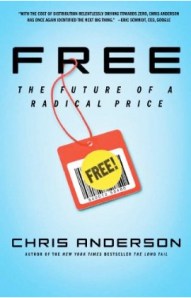
freecoverLatest blow to Chris Anderson’s argument that Free stuff always prevails — feevee subs are continuing to hold their own in this wretched economy, despite more cost free alternatives than ever. HBO and Showtime execs proudly touted this fact at the TV press tour last week, just days after Anderson’s grumpy interview with Germany’s Spiegel went viral.

Among the bon mots in that interview: “Free is the force of gravity.”

Don’t get it? Let him explain: “If we decide to resist it then somebody else will compete with something that is free. The marketplace follows the underlying economics. You can be free or you can compete with free.”

He then argues that Wall Street Journal “cleverly” uses free content to convert people to paid content — a variation of his argument in the book that HBO uses free content on YouTube to drive subscriptions. Neither tracks. People subscribe to HBO and the Wall Street Journal because they value the quality of the content. Other outlets haven’t been able to succeed with the same argument, but that doesn’t diminish either the WSJ or HBO’s achievement: Sometimes consumers ARE willing to pay, other times they aren’t. In fact, as The Wrap points out, feevee channels are doing well at a time when broadcast nets are struggling.

Sheesh.

Earlier: Glad she asked: ‘Free’ prodder; ‘Free’: A paradox of expediency

Oh snap out of it: Why midlife crises can be so boring

Books, Writing

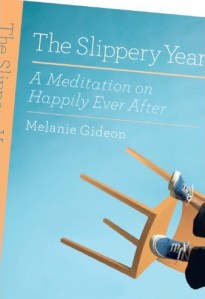
slipperyyearYou know the saying that happy families are all alike? I’m thinking there should be an addendum: Midlife crisis stories are inherently boring. Vague unease and ennui do not make for compelling drama.

Latest case in point: “The Slippery Year,” by Melanie Gideon. I so wanted to like the book, which got a write-up in today’s NYT in advance of its arrival next week, that I plowed my way through it waiting for the revelation or wisdom that would make reading it seem worthwhile. Sadly, it never came.

Gideon, no doubt a nice person if you know her, makes much too much ado about mundane domestic details and disappointments. Her husband buys a big motor home; she hates it. Her son needs a new Halloween costume; she’s a bad mother for talking him into trick-or-treating as wrongly incarcerated fallen angel. The dog dies. She and her husband can’t find a new bed they can both sleep upon. And so on.

Will this marriage last? Can she shake out of her funk? Do we really care? Gideon certainly isn’t interesting or insightful enough to make me care about her particular blues.

‘Hurt Locker’: Shock and awe

box office, DG Creations, Movies, Writing

hurtlocker

Have to admit I was skeptical about “The Hurt Locker” despite all the rave reviews. Hadn’t I already seen a bunch of less-than-satisfying Iraq War movies? And when was the last time I enjoyed a Kathryn Bigelow movie – “Point Break”? That was 1991.

Happily, this was one movie that lived up to the hype. “The Hurt Locker” lays waste to all its Iraq war predecessors, and it does so in a straight-ahead manner lacking overt Hollywood sentimentality or symbolism. Watching the movie you get a sense of the dread, danger and uncertainty of war.

In that way, the movie reminded me of “Platoon.” But “The Hurt Locker” is much more dialed back; there are no operatic battles for the soul of a wide-eyed grunt in this movie. Sure, there are goners – war is hell, after all – but Bigelow spares sentimental foreshadowing so common in war movies. This just adds to the “will they or won’t they” suspense when the soldiers are out in the field waiting for Jeremy Renner’s bomb specialist to defuse explosives.

Summit is releasing the movie very carefully – it took a month before it expanded to the South Bay – but so far the strategy seems to be working. The pic earned $1.4 million from 238 theaters over the weekend, a big tick up from the previous frame.

One big surprise: My Friday afternoon aud skewed about 70/30 male/female. Given the rhapsodic reviews, I thought cinephiles of both genders would eagerly turn out. It’s definitely worth a look.

Wyatt Cenac, vampire of comedy

comedy, DG Creations, digital media, TV, Variety, Writing

wyattIn case you were wondering, Wyatt Cenac is not one of those rat-tat-tat jokesters in person. Not at first meeting, anyway. But make no mistake about it — he’s very droll. And sly.

During our interview a few weeks back, he made several stealth points about Sarah Palin and the media. Sadly, they didn’t make it in my Variety Comic to Watch profile, linked here. Not enough space to do them justice; besides, sometimes you have to be along for the ride.

Cenac, “Daily Show” exec producer Josh Lieb observed, is deceptive — he seems innocent but is very sharp-witted. When you relax your guard, “that’s when he kills you. He’s a vampire of comedy.”

If you have a few minutes, treat yourself to a couple of his bits from “The Daily Show.” In “Judgmental,” he amusingly riffs on Sonia Sotomayor’s name and supposed gang ties; in “Fled Sanford,” he wildly speculates about Gov. Mark Sanford’s activities while supposedly hiking the Appalachian Trail. I love how he breaks up during the latter.

Also wrote three profiles for the companion Comedy Impact Report: One on Sandra Bullock, who showed she still has serious comedic chops in “The Proposal”; another on comedians’ use of Twitter; and a third on Comedy Central’s Web sites, led by Erik Flannigan.

Glad she asked! ‘Free’ prodder

Books, digital media, N.Y. Times, Writing

Deborah Solomon, she of the penetrating questions, took Chris Anderson to task for l’affaire Wikipedia in yesterday’s NYT, eliciting a revealing exchange.

First she asked whether he considered plagiarism an extension of his freebie thesis, which batted down thusly:

“I wish I could explain all my actions as being intellectually consistent, but this one is just plain old sloppiness. There are questions about whether one should cite Wikipedia, and I’m one of those who think you should.”

Nice slight of hand: He starts out on a self-deprecating note, then asserts a sense of honor about, of all things, crediting Wikipedia in a supposedly rigorous economic treatise. Luckily, Solomon calls him on it.

“Frankly, if you want to be a public intellectual, you shouldn’t be using Wikipedia to research a book of ideas in the first place,” she observes.

Anderson’s less than satisfactory response: “The level of scholarship and analysis on Wikipedia is improving by the day, and we ignore it at our peril.”

Again, note the self-righteous tone. Anderson clearly has the power of his convictions.

Solomon also touches on the quality issue, which bugged me so, noting that people have proven willing to pay subscription fees for HBO, but Anderson rejects that model as so 15 years ago. “The marketplace wants free,” he parries. “Consumers want free, and if you decide to set up a subscription service, then your competitor will make a free one.”

Did I miss something here? Is HBO really suffering because of the free TV or Web programming? If anything, struggles to replicate earlier programming success — a quality issue — seem to have been the issue. And I won’t even reiterate the iTunes example. Oh wait, I just did.

‘Free’: A paradox of expediency

digital media, Writing

freecoverRaced through Chris Anderson’s “Free” online and while I’m not as critical as Malcolm Gladwell, I do have several issues with the book.

1. Anderson lets the book and mag bizzes off lightly. Is this because he wrote the book before the market REALLY took a dump, dragging both industries down along with the already cratering newspaper biz? Or is something more disingenuous going on here? After all he has a stake in both worlds as editor of Wired and book author. Anderson states that “books are a special case of print, like some glossy magazines, where the physical form is still preferred by most. The book industry is not in collapse, thankfully,” he continues, but this has not stopped “hundreds of authors” from experimenting in free with video interviews and the like.

That’s simply not true. The economic slump has hit the mag and book biz hard. Few glossies have been impervious; Wired has certainly taken its lumps, as outlined by the NYT not too long ago. Anderson himself alludes to disappearing bookstore shelves and newspaper book review sections shortly after this pronouncement.

This isn’t the only selective interpretation.

2. Anderson’s so blinded by his celebration of Free that he gives short shrift to counter phenoms. As convincing as he is describing how content creators and consumers can benefit from giving away their goods, he never really adequately explains why certain consumers willing pay for goods readily available for free elsewhere. King Gillette gave away razors to build demand for razor blades, just like the makers of Jell-O gave away free cookbooks to seed demand for the floundering dessert product. But Apple charges for music that can be found elsewhere for free, and sells millions of portable media devices at a healthy price.

Anderson argues that Apple is a beneficiary of Free because so many play free MP3s on iPod devices, and attributes the popularity of iPods to their storage capacity. “Before the iPod, nobody was asking to carry around an entire music collection in their pocket,” he writes. “But engineers at Apple understood the economics of abundance.” Supply created its own demand, he concludes.

This passage suggests Apple alone saw the market for portable MP3 players, when in fact Apple entered the market well after its competition and succeeded by selling, and marketing the hell out of, a sleek easy to use player. Apple doesn’t try to undersell the competition; it tries to create products consumers have got to have.

HBO follows much the same approach. But Anderson chooses to focus on the pay channel’s use of free clips on YouTube rather than its ability to command a premium. Never mind that free online clips are standard marketing procedure in Hollywood.

3.  Anderson never adequately addresses where quality and aesthetics fit in the Free equation. He does acknowledge Hulu’s popularity, and ability to draw more advertising than YouTube due to consumer appetite for professionally produced content. But mostly he  fixates on the tension between abundance and scarcity. It’s true that the digital revolution has lowered distribution costs tremendously, making it possible for amateurs to compete against the pros. If information really wants to be free, as Anderson argues, companies like Apple and HBO wouldn’t be so successful charging for their content.

Stewart Brand, who originally popularized the phrase, calls this apparent contradiction a paradox, noting that the tension between free and expensive information is what makes it so interesting. What’s more, he tells Anderson, “paradoxes keep themselves going because every time you acknowledge the truth of one side you’re going to get caught from behind by the truth on the other side.”

In other words, good luck pinning this down.

To give Anderson credit, he does a good job explaining the psychology of free and various returns content creators get from free goods. Besides traditional third-party exchanges (advertisers for access to viewers), there is “Freemium,” wherein creators up sell consumers. Bloggers, meanwhile, use “gift economy” to parlay the recognition they get from their free posts into paid assignments and speaking engagements.

Anderson practices what he preaches: He makes money from speaking engagements and has made this book briefly available for free online; he primed the pump with a cover story in his magazine. He also kept his own costs down by relying heavily on Wikipedia, a free but hardly unimpeachable source, then got into hot water when the material was not properly attributed in the book. Unfortunately his penchant for repurposing devalues “Free.” Is a book so readily available elsewhere really worth $26.99? Especially when it already seems dated? So much for its subtitle, “The Future of a Radical Price.”

As Virginia Postrel writes in her cogent NYT review, “the book is less about the future than the present and recent past, which Anderson surveys in a cheerful, can-do voice.”

There is much to be sorted out in the digital transformation of our culture. Too bad Anderson doesn’t see the value of quality control in the new land of the Free.

‘Stuffed’: Not nearly tasty enough

Books, New England, Writing
Norwich Inn: Their burgers are just right

Norwich Inn: The burgers are just right

When I went to New England not that long ago, one thing that struck me was the retro portions restaurants served. It seemed so old-fashioned — and so right.

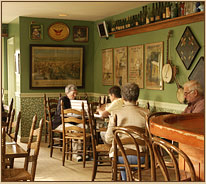
A sandwich at a Woodstock, Vt., luncheonette evoked childhood meals made with Pepperidge Farm slices, easily a third smaller than those from typical loafs these days. A burger at a nearby historic inn was properly proportioned as well, and accompanied by tasty greens and a smattering of chips. Even the bakeries in New England seemed like throwbacks: No huge gobs of icing or ridiculously large portions, as commonly found even in supposedly diet conscious L.A.

Naturally, it made me wonder: Did flinty New Englanders simply reject the Super Size trend? Are their waistbands smaller as a consequence? A quick check of national obesity levels confirmed my suspicion: New England has the lowest level in the country, tho sad to say it is on the rise there as well. The South wins the dubious honor as most obese; individual states like California have pockets of greater and lower obesity.

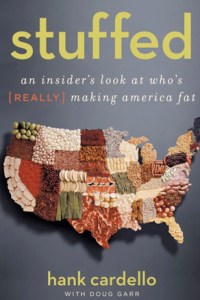
stuffed“Stuffed,” a book by a former General Mills and Coca-Cola exec, attempts to explain why America has grown so fat. With the zeal of a reformed smoker, Hank Cardello points his finger at a wide array of culprits: packaged good companies, grocers, restaurants, schools and sedentary consumers who just don’t know how to say no. He outlines the economic reasons behind upsizing and school deals with fast food companies, as well as the cautious resistance to any change in status quo.

Sprinkled throughout are his well meaning, but at times dubious suggestions for ways to reduce Americans’ caloric load. He spends a lot of time, for example, outlining his efforts to convince fast food restaurants to switch to healthier frying oil, and his failed attempt to convince General Mills to create a healthy kids food line under the Sprout name. But it’s not clear how much a difference either would have made. He also suggests a healthier type of Nestle Crunch bar while seemingly endorsing the recent changes in chocolate standards; never does he acknowledge the fact that the “improved” chocolate tastes much worse. Nestle Crunch bars, like so much American chocolate these days, taste waxy and devoid of flavor; not much of a treat to eat.

People like to eat in Stockton, Calif.

People like to eat in Stockton, Calif.

In other parts of the book, Cardello acknowledges that foodies pay more for smaller portions made from better (and tastier) ingredients. Is there no way to move back in that direction, rather than tinkering with the formula of oils and sugars used to make popular junk food? Why can’t more food purveyors take a page out of New England’s book?

The other drawback to “Stuffed” is the prose itself. Cardello, who co-authored it with journo Doug Garr, is regrettably earnest. And even when he’s addressing a topic with much comic potential — as the “Cupcake Wars” at schools — he plays it lamentably straight.
“Will the cupcake survive the obesity wars, or will it suffer the fate of other, less worthy, food casualties?” he queries, somewhat portentously.

Nonetheless, Cardello should be lauded for shining a spotlight on this perplexing problem, and sharing his insider’s take on how it got so huge.

‘Beverly Hills Adjacent’: Where to begin?

chick lit, New York Times, Writing

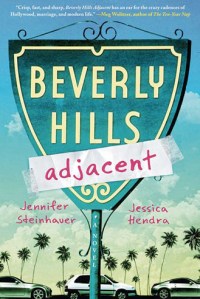
bevhillsadjacentI’ll say this for Jennifer Steinhauer: She definitely writes about what she knows in “Beverly Hills Adjacent.” The L.A. Bureau Chief for the NYT drowns her first novel, co-written by actress-author Jessica Hendra, with knowing details and familiar showbiz figures. Some are so thinly-disguised, in fact, you wonder why they bothered. (Jenna Mills for Jenna Elfman? Couldn’t they do better?)

What I can’t understand is why Steinhauer decided to write such a frothy piece of chick lit. It seems strange for a journo charged with directing hard news coverage to go in such a direction. Sure, other newspaper reporters write: Mary McNamara contributed a similarly frothy tome titled “Oscar Season” a year ago, but she’s an entertainment reporter, now TV critic, for LAT, and does not oversee hard news. Male reporters have written their fair share of genre fiction over the years, but those have tended toward mystery novels with some death to add a harder edge. I can’t think of anything this fluffy from a newspaper journo of her stature. Maybe I’m just forgetting.

Steinhauer further muddied the waters by letting Jamie Lynton, wife of Sony Pictures honcho Michael, host a book party at their house. When Gawker called her out on it, the scribe brushed aside any suggestion of conflict of interest, parrying, “Do I cover the movie beat?” She pointed out that she has nothing to do with cultural coverage, and reports to the national desk. Her husband Ed Wyatt, however, is a TV reporter for the paper.

To make matters worse, the book isn’t that good. There are funny moments, and compelling enough characters to carry readers through, but overall the material’s very thin. Like many beginning novelists, the writers mistake brand names and established regional haunts for character development. Of course the exercise moms prefer Sprinkles cupcakes to June’s hand-crafted ginger cookies! And they wear stretchy yoga pants everywhere! Maybe this will seem fresh to outsiders, but it’s very obvious to anyone who’s spent time in, or around, showbiz. Would that the writers spent a little more time on creating characters rather than types and oppressive scene setting.

As McNamara noted in her LAT review, the book “is so front-loaded with details it almost collapses: It’s not just a cupcake from Sprinkles, it’s a red velvet cupcake from Sprinkles; a character didn’t just wait tables when she came to L.A., she waitressed at Kate Mantilini.” A little local accuracy adds flavor, McNamara writes, but the volume here threatens to consume the story line.

The two main characters, UCLA prof June and her character actor husband Mitch are the most fully realized. The book follows their tandem career crises — his comic battle to get cast during pilot season and her struggle to remain faithful as she vies for tenure. Naturally, there’s plenty of second guessing about their move to L.A. from New York, where Mitch pursued theater, not big bucks.

The writing improves toward the end, becoming more fluid and less epigrammatic. Perhaps Steinhauer’s next novel will take up where she left off, and not head down the same tired road again.

Writer’s divorce stings LAT media critic

journalism, L.A. Times, mags, Writing

Some gall of Sandra Tsing Loh to turn her back on marriage! All those zany tales about parenting and she has the nerve to question the notion of wedded bliss? Why, her Atlantic story doesn’t even serve up juicy details about her affair! 

LAT media columnist James Rainey takes her defection VERY personally, writing in Wednesday’s paper that Loh’s case against nuptials left him dismayed and “oddly defensive on behalf of her husband.” He claims that her essay goes too far and doesn’t reveal enough, calling it “thoroughly provocative and strangely bloodless.” His issue: that she uses her experiences and that of a few friends to make a sweeping case against marriage without outlining the specifics of her marital breakdown.

Rainey really wants it both ways. He questions whether “the personal necessarily must become political,” yet clamors for more details so that — what? — he can better assess her argument? Make sense of  her marital breakdown?  He seems appalled Loh would mine her private life for public consumption, but that’s what she does. It’s just that usually she does so for comic effect.

I actually found her Atlantic essay bracing. Her radio bits and prose have always seemed self-satisfied; she’s very intent on conveying how wacky and boho her life is.  “Mother on Fire,” as her last book is prophetically titled, chronicles one comic adventure after another as she tries to get her children into good schools, often circumventing her kind, but relaxed, musician husband. Oh, and she also writes about her chronic insomnia, another tell-tale sign of her unhappiness in retrospect, but as per usual she makes a joke of it. 

The jokes are gone in the Atlantic essay. Sure she serves up telling, if disguised, details about her pals in “Let’s Call the Whole Thing Off,” but the self-satisfied tone is absent. Loh honestly seems to be grappling with the issue of modern-day marriage in the wake of her own failed 20-year partnership, melding  her personal views with readings from marriage books. I don’t share her bleak conclusion, but I don’t begrudge her attempt to make sense of it all.

Then again, my manhood isn’t being called into the question, so maybe it’s easier for me to be sanguine about her sour take. Rainey admits he “couldn’t help but feel the pain the latest production must have provoked” for Loh’s long-suffering mate. “How many times can you be labeled a ‘great artist and loving father’ and a ‘worthy man’ before you feel like an emasculated chump?” He further bristles at the way she depicts friends’ mates as “domesticated sexless drones.”

Strangely, he suggests that her marriage would have been better off if she had only moved to South Pasadena, as she once wished. “The little city where I live might not be perfect, but it seems to me that most of the couples we know enjoy much better than the joyless ‘companionate marriages’ Loh dreads,” he writes. Now, I’ve lived in South Pas, and I like it there, but the city has no greater guarantee of happy marriage than other Los Angeles suburbs. Suggesting it, Rainey’s guilty of the same sort of sweeping generalization he criticizes Loh for making.

Rediscovering Sunset

media, Writing

sunset1973 There are times I feel frightfully middle-aged. Like when I watched my classmates shimmy alongside much younger alums at our reunion a couple weeks back. Today I was thrown by how much I enjoyed the latest issue of Sunset magazine. How could this be? I’ve always considered Sunset a mag for California housewives… and I’m definitely not that.
 
When I first checked out Sunset in the early ’70s, we were new to California, and the magazine seemed as exotic as the Birds of Paradise in our backyard. There were layouts on lanais and Asian-inspired recipes unlike anything in McCalls or Better Homes and Gardens, two of the other mags Mom subscribed to back then. Even though we didn’t stay long in SoCal, my mother relied on the Sunset recipe for potstickers for years, serving them up where ever we were living at the time. (We moved a lot as my Dad climbed the corporate ladder.)  

Today’s Sunset doesn’t seem nearly as exotic, but it’s refreshing  in its focus on home, travel and outdoor living. No giddy sex tips, parenting tribulations or couples counseling. There’s enough of that elsewhere; believe me, I don’t miss it.